How Do You Know a Lead Turned Into a Rental?
You would never accept a monthly report from your yard that said "40 units went out."
You want to know which machines, to which contractors, for how long, and at what rate. That is the whole point of a rental contract.
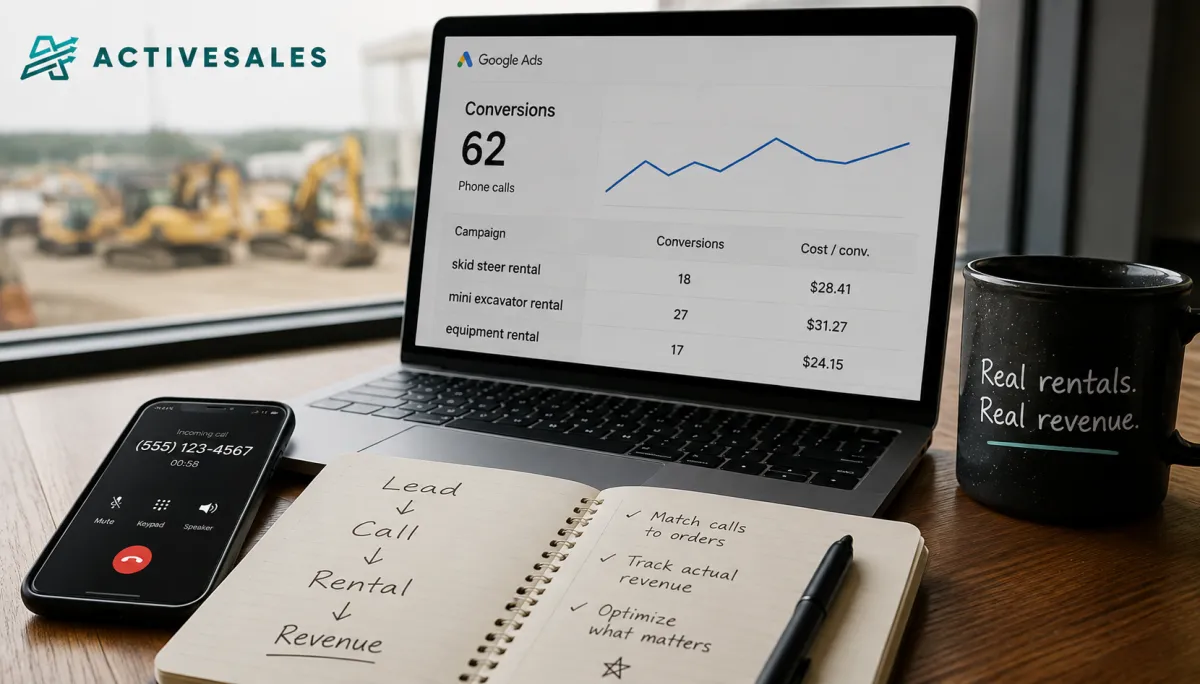
Now look at your Google Ads report. It might show thousands of conversions. That sounds great until you look at what those conversions actually represent.
That is the gap. Google counts a phone call as a conversion the moment it lasts longer than your minimum, usually 60 seconds.
It cannot tell the difference between a contractor booking a mini excavator for three weeks and somebody asking whether you are hiring. Both look identical in the account, and both get treated as a win.
Why it costs you money, not just clarity
If it were only a reporting problem, you could live with it. It is not, because of how automated bidding works.
Smart bidding optimizes toward whatever you count. Feed it thousands of conversions of equal weight and it will go find you more of the cheapest ones. Cheap conversions in a rental yard are hand tools, weekend homeowners, and price shoppers.
Expensive conversions are the excavator calls.
Say your blended cost per lead is $30. Is that good? You cannot tell. $30 for a lead that turns into an $1,800 week on a machine is excellent. $30 for a lead that turns into a $40 sander rental, or into no rental at all, is a bad trade you are quietly making dozens of times a month.
Google is not doing anything wrong here. It is optimizing exactly what you asked it to optimize. You just asked for the wrong thing.
Closing the loop with what you already have
Here is the useful part: you almost certainly already own both halves of the answer. They just live in two different systems that have never spoken to each other.
Your call tracking (CallRail, Convirza, whichever you use) knows the source of every call. It knows this one came from a Google Ads click on "skid steer rental," that one came from organic, that one came from your Maps listing. It also captures the caller's phone number.
Your rental software knows every order you booked, what it was worth, and who booked it.
The phone number is the join. Export the calls, export the orders, match on the number, and you stop looking at calls by source and start looking at revenue by source. That is a different conversation entirely.

The part nobody warns you about
There is one annoying gap that can stop you cold the first time you try to connect your rental data with your call data.
Your rental software has the transaction details you need: what was rented, what it was worth, when it was booked, and which customer placed the order. But the customer information and the transaction information may live in separate parts of the system.
That means matching the data is not always as simple as exporting one report and comparing it with your calls. You may need to connect the rental transactions to the customer record first, then use the customer's phone number to match that customer back to your call tracking data.
It is a simple problem once you know it is there, but it is easy to waste hours trying to figure out why the numbers do not line up.
A few other things to expect, so the first result does not spook you:
Your match rate will not be 100%, and it should not be. Walk-ins, house accounts that call from the office line, repeat customers dialing from a different cell, and every deal that started as a form fill will all miss. Somewhere around half is normal and still useful, because you are not trying to audit your revenue. You are trying to rank your sources, and the ranking holds up long before the matching is perfect.
Your rental cycle is longer than the ad platform's memory. A contractor who called in March about a trencher may book in May. If you only match inside a 30 day window, you will undercount your best, slowest, largest jobs, which are exactly the ones you want to bid more for.
Then feed it back
Matching in a spreadsheet already tells you where to move budget. But the bigger win is sending that information back into Google as offline conversion data, so the bidding itself starts chasing booked revenue instead of ringing phones.
That is where most agencies stop, and it is worth asking yours why. The setup is not glamorous, it does not produce a nice slide, and it makes the reported cost per lead look worse, because you just deleted the junk that was flattering the number. A cost per lead that goes from $22 to $61 and starts counting only real bookings is not a decline. It is the first honest number the account has produced.
The short version
Every rental company can tell you which machine went out yesterday. Almost none can tell you which ad paid for it.
Do this now: export your last 90 days of calls from your call tracking platform, export the same period of orders from your rental software, and match them on phone number. Do not build anything, do not buy anything, just get the two files side by side. Sort the result by revenue and see which source is actually paying for the yard.
Most owners find the ranking is not what the ad dashboard has been telling them, and that surprise is worth more than any report you are currently receiving.
We only do Google Ads for equipment rental companies. If you want a second set of eyes on your account, we will take an honest look and tell you what we see.