A note on rental values: The figures in this case study represent quoted rental opportunities, not confirmed revenue. Given the low search volume and long sales cycles in specialized heavy equipment rental, waiting for signed contracts would delay the data Google Ads needs to optimize effectively. Together with the client, we decided to track the potential value of each qualified call. When the rental operator identifies a genuine rental opportunity and sends a quote, that quoted value is recorded in CallRail. Contracts of this size can take several months to negotiate and finalize. This approach allows us to feed meaningful value data into Google Ads earlier in the sales process.
The Client's Background
This company has rented heavy equipment for decades. Contractors know the name, and most of the business comes through word of mouth. The owner did not believe in Google Ads at all. In his words, word of mouth is the only thing that works in rental.
Then the company opened a second location, and the phone stayed quiet. Decades of reputation did not travel with it. At the new yard, nobody knew the name and nobody called.
The Situation
The fleet is heavy and specialized: large trenchers, rocksaws, excavators and backhoes, rented mostly to utility, pipeline and site contractors. A single rental can run for weeks or months and be worth tens of thousands of dollars. That changes how advertising has to work:
- The audience is small. Few people search for a rocksaw or a Tesmec trencher, so every one of those searches matters.
- One call can pay for a year of ads. The goal is not the most calls, it is the right calls.
- The wrong clicks are expensive. Homeowners looking for a small walk-behind trencher, or people looking to buy, can use up a small budget fast.
The new location had no ad history, no conversion tracking and no call tracking. We created a new Google Ads account on January 19, 2026, and launched three days later.
What We Did
- Call tracking from day one. CallRail gives the Google Business Profile and the ad call extensions their own numbers, and a number pool on the website shows which source each caller came from. Only phone calls and quote requests count as conversions. Calls are listened to and logged, so we know which ones became rentals.
- One campaign per machine type, each sending people to that machine's page for the new location, targeting the whole state, because heavy equipment is delivered far beyond the yard.
- The budget moved to what rings the phone. After two months we paused the machines that brought too few calls (dozers, loaders, rollers, graders) and put the whole budget behind trenchers, rocksaws, excavators and backhoes. Ads run on working days, when the counter can answer.
- Search terms cleaned up continuously, blocking homeowners, buyers and people looking for small tools, so a limited budget goes to contractors.
Results
The campaigns went live on January 22, 2026. Within three weeks, two calls from Google Ads turned into quotes for long-term trencher rentals, logged in CallRail at $52,000 and $42,000.
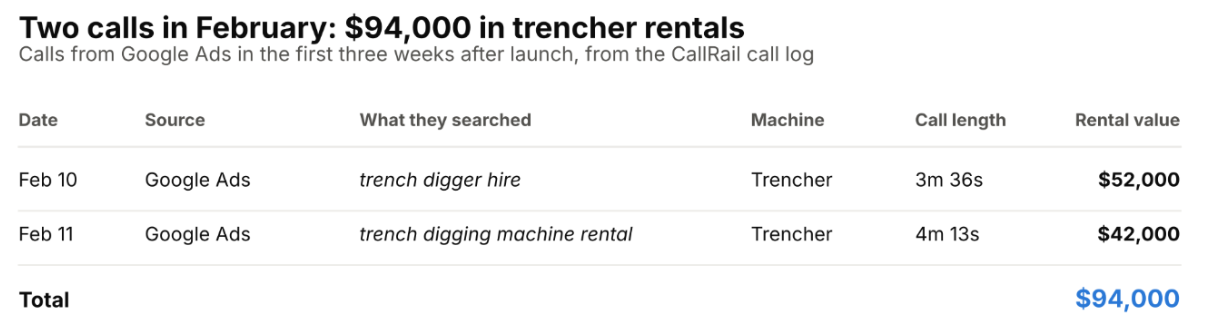
Together, those two quotes are worth many times what the ads have cost.
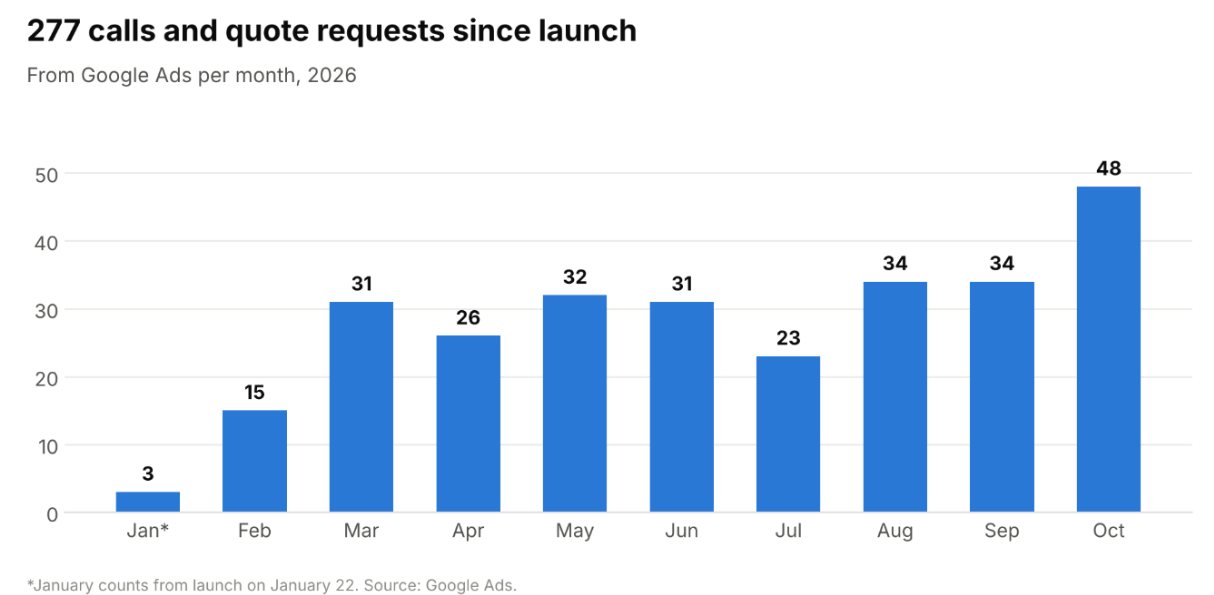
Since then the phone has kept ringing: 277 calls and quote requests from Google Ads since launch, on about the same budget every month. The owner who believed only in word of mouth now has a new location with a phone that rings.
Adding Microsoft Ads (Bing)
For most rental companies we would not recommend Bing. There are fewer searches, and Google usually covers the demand. This client is the exception: when one rental can be worth tens of thousands of dollars, even a channel with fewer calls can pay off.
We opened a new Microsoft Ads account, built campaigns for the core machines (trenchers, rocksaws, excavators and backhoes) and tracked every call through CallRail, just like Google.
CallRail has recorded 93 calls from Bing since February. Bing brings fewer calls than Google, but some of them are worth a lot: in two days in May, two calls that started on Bing were logged at $30,000 each, one for a trencher and one for an excavator.
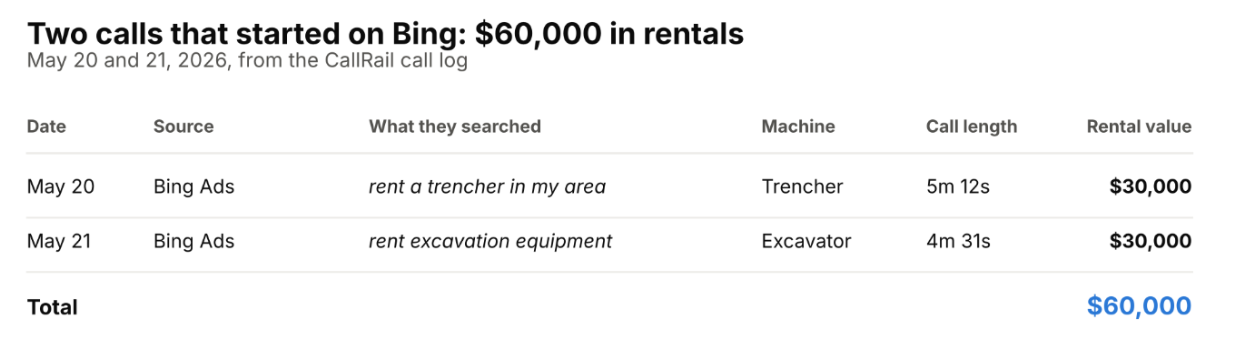
Google brings a steady flow of calls. Bing brings the occasional very high-value quote. For heavy equipment, a channel does not need many calls to be worth it. It needs the right ones.
What the Calls Told Us
Listening to the calls showed something no ad report would: people were calling to ask for machines the company does not have. In a single summer we logged requests for six different machines outside its fleet, from a Cat 374 excavator to a mulcher, a bulldozer and a SkyTrak telehandler. One caller had to be sent to a competitor: a rental lost only because the machine was not in the fleet.
That is not wasted ad spend. It is cheap market research: real contractors telling the owner exactly what they would rent from him if he had it.
This is why our focus is not on clicks or call volume, but on what happens after the phone rings, and on making sure every dollar of ad spend turns into rentals for the business.
Rental values are the values logged against each call in CallRail. Google Ads figures come from the client's account. A conversion is a phone call or a quote request.